AI Inference Services for Operational Flows Forecasting, Problem Detection and Response
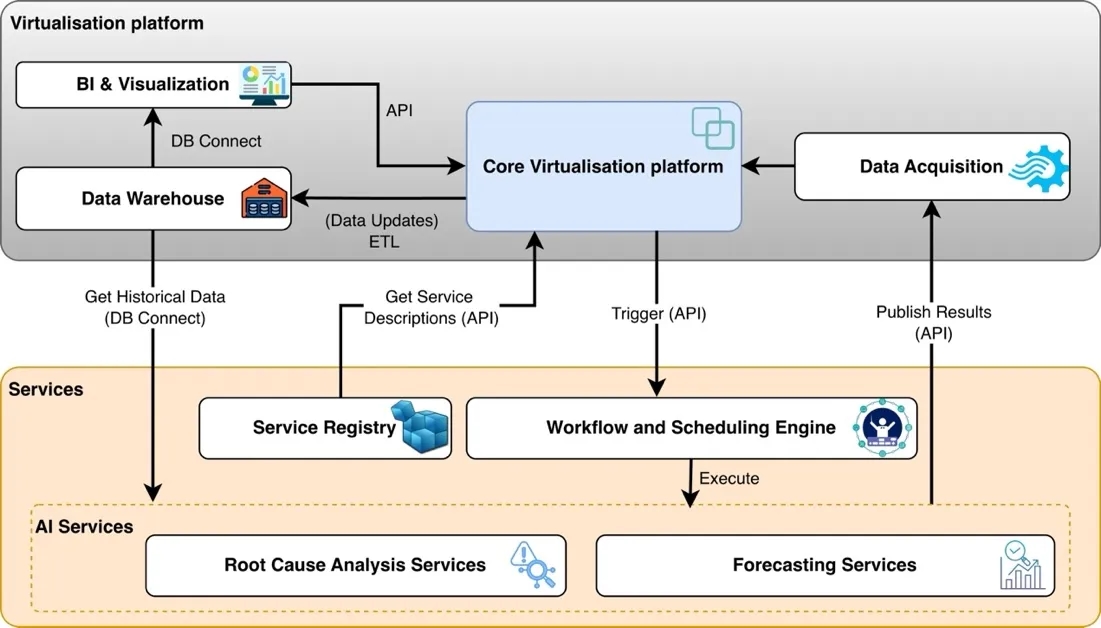
The AI Inference Services provide configurable analytics and optimisation intelligence for CSSBoost. They support forecasting, anomaly detection, telemetry correlation, root-cause analysis and decision support on top of data integrated through the Virtualisation Platform.
Machine-learning and time-series forecasting algorithms.
Forecasting of target variables and upcoming events.
Anomaly detection, telemetry correlations and root-cause analysis.
On-the-Fly AI Services for low-latency computations.
Model-Based AI Services for training and inference using historical data.
Configurable AI pipelines with user-defined service instances.
Airflow DAG-based execution for model-based services.
A forecasting service is configured with a telemetry source, historical window, forecast horizon and any relevant seasonality settings. Model-based approaches also require suitable historical data for training and evaluation. Correlation and deviation analysis need time-aligned series and appropriate handling of missing observations. An output data source is configured so that forecasts or analytical results can be returned to the platform and visualised with other measurements.
A forecasting-service selector, additional forecasting services and anomaly detection have been implemented. Root-cause analysis is being finalised, while new applications using Marche and Lisbon pilot data are being explored. CSSBoost AI inference services are designed to analyse operational time series, forecast future values and investigate deviations within a circular value chain. The architecture distinguishes on-the-fly methods, which can work without a separately trained model, from model-based approaches that use historical data for training and evaluation. A service configuration identifies the telemetry source, historical window, forecast horizon, seasonality assumptions and destination for the results. Workflow execution connects these inputs to the selected analytical method and returns outputs as data that can be visualised alongside other platform measurements. The development includes approaches such as moving averages, ARIMA and seasonal ARIMA, Prophet and LSTM models. The analytical scope also includes time-aligned correlation and the investigation of possible relationships around operational deviations. Root-cause-analysis development considers temporal relationships, changes in behaviour and model-based feature information. These functions support exploration and decision-making rather than establishing causation automatically. Their usefulness depends on the coverage, consistency and quality of the historical data and on validation of the selected method for the pilot application.
Extend pilot use cases, improve the service registry, validate model accuracy and improve presentation of analytical outputs.
Time-stamped operational data, relevant process variables, training/validation periods and known-event labels where available.
Forecasts, anomaly signals and analytical explanations. Model accuracy is assessed for each pilot application.
Services integrate through the documented AI service architecture and regional platform; pilot deployment and input-data readiness vary.