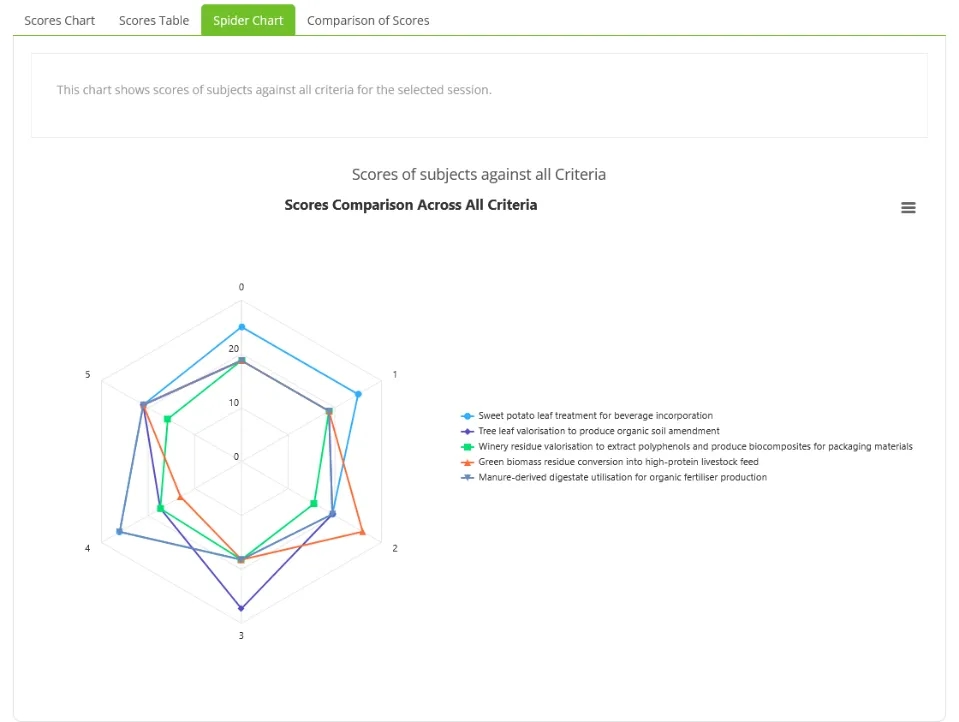
Planning starts with a defined decision context and a set of candidate circular practices. Users establish the evaluation criteria and contribute the scores and weights used for comparison. The framework considers environmental, financial, circularity, technological, social and cooperation aspects. Individual and multi-stakeholder inputs support the ranking of alternatives, alongside information on risks and potential implementation barriers.
Search and filter the CSS Inventory, define decision options and criteria, assign weights and scores, and explore evaluations, charts and rankings. Moderators can review group evaluations and manage participants and criteria. Public browsing and authenticated decision sessions have different access roles. The CSS Application Planning Toolkit helps stakeholders explore, assess and compare Circular Systemic Solutions when planning a circular-economy intervention. It builds on the CSS Inventory, which brings together practices, technologies and application cases from agricultural, livestock and food-processing by-products, water, plastics, batteries and vehicles, and crosscutting topics. The assessment framework considers environmental sustainability, financial efficiency, circularity, technological maturity, social impact and the level of cooperation. A dynamic multi-stakeholder, multi-criteria method supports evaluation and ranking, allowing different considerations to be brought into the decision process. The Toolkit also includes risk pre-assessment, potential implementation barriers and pathways for addressing those barriers. It therefore supports the early planning stage, when stakeholders need to understand both the attraction of a solution and the conditions that could affect its application. The tool and its user guidance were completed within the project's application-planning work. Its outputs support informed selection and discussion; implementation decisions still depend on the characteristics of the intended region, value chain and participating actors.
Expand the available practices, criteria and information, and connect the toolkit with the Marketplace and Technology Evidence Base.
Candidate circular practices, a defined decision context, evaluation criteria, participant scores and criterion weights.
Comparative scores, criterion-weight visualisations, option rankings and individual or moderated group evaluations based on the selected preferences and supporting information.
Web-browser interface, with Marketplace and Technology Evidence Base integration under development.
Internet browser for public exploration. Registration and the appropriate participant, moderator or administrator role are required for decision-session functions. TUC manages registrations and role assignment.