Sustainability Balanced Scorecard (SBSC)
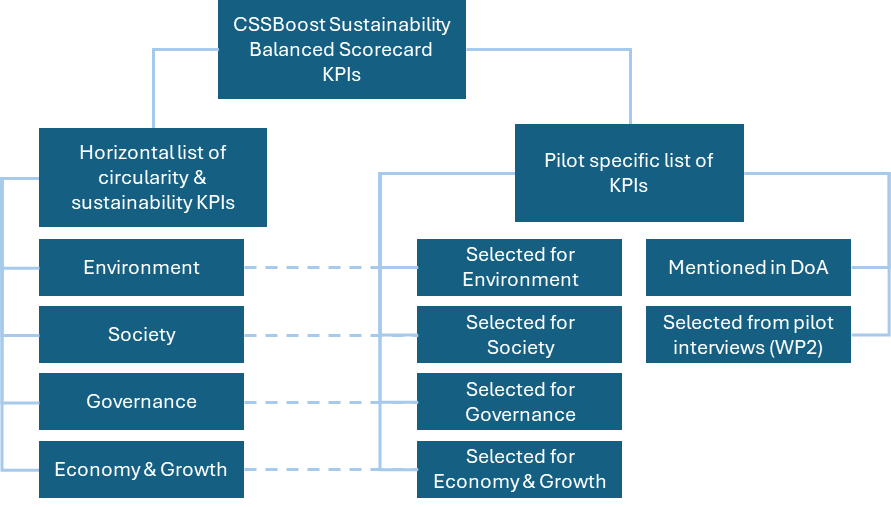
SBSC develops a benchmarking approach for circularity assessment across a process, industry, value chain or region. With the models created by PSM as a starting point, KPIs can be selected according to each pilot’s preferences and needs, so that calculated results provide informed sustainability and circularity evaluations.
Extended catalogue of generic KPIs within PSM.
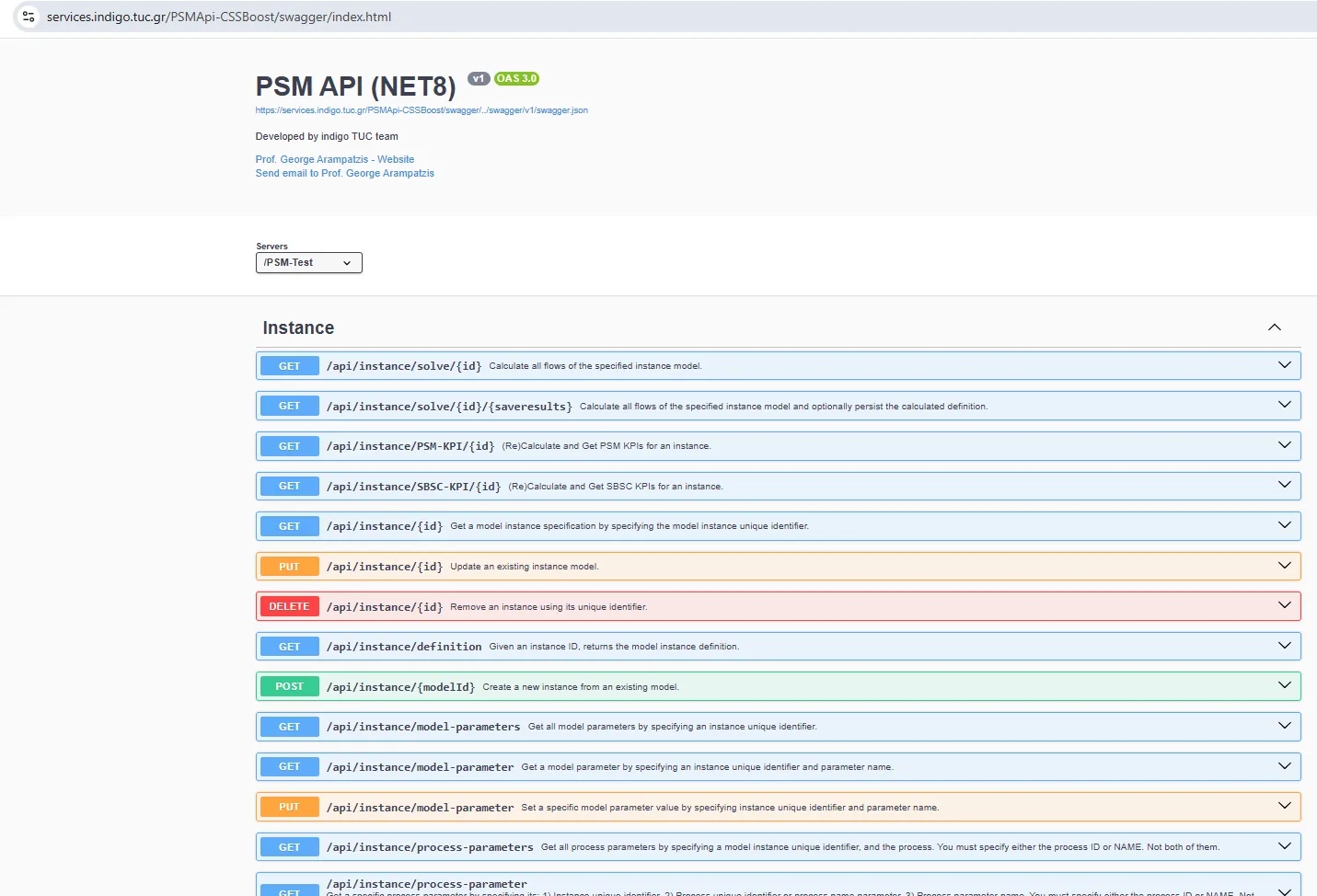
KPI scripting through a .vb-based Script Editor.
Definition of dependencies, mathematical relations and conditions.
Calculation of local and system-wide contributions to sustainability performance.
Visual scorecards for presenting KPI results.
Support for pilot-specific KPI validation and incorporation into PSM.
The scorecard uses defined indicators associated with the environmental, financial and growth, social, and governance perspectives. Quantitative indicators require their calculation logic and the corresponding process or value-chain data. Qualitative indicators can use manually entered or survey-derived information. Standard and application-specific measures can be combined, provided that each indicator retains a clear meaning and an appropriate relationship to the process or scenario being assessed.
The scorecard framework combines common and pilot-specific sustainability indicators. Work with pilot partners is shaping a targeted KPI survey and the data needed for assessment. The Sustainability Balanced Scorecard (SBSC) organises the assessment of a circular value chain across four perspectives: environment, financial and growth performance, society, and governance. It provides a way to consider these dimensions together, rather than reducing the evaluation to a single material or environmental indicator. Implemented within the PSM environment, the scorecard allows users to define and manage indicators and relate them to processes or to the wider value chain. Standard indicators can be complemented by custom indicators appropriate to the application. Quantitative calculations can use model and operational data, while qualitative or survey-based information can be entered where the assessment requires it. The approach supports the examination of performance trends and alternative scenarios. Changes in process parameters or value-chain configurations can be considered alongside the corresponding sustainability measures, helping stakeholders explore trade-offs. The meaning of each result depends on the indicator definition, calculation logic and input information. The scorecard therefore complements detailed methods such as LCA and material-flow analysis by bringing their outputs into a broader decision-support structure.
Finalise and distribute the KPI survey; agree definitions and baselines with pilot partners and integrate validated inputs into scorecards.
Agreed objectives, KPI definitions, baseline and observation data, targets, boundaries, units and weighting choices.
Structured indicator views and sustainability comparisons, with pilot scores to be populated using validated data.
Planned alignment with PSM, dynamic LCA and the regional information sharing platform.