Pilot 5: Interregional Virtual Circular Value Chain Integration
The virtual pilot connects knowledge and data from the regional demonstrations to explore how circular value chains can be combined, transferred and scaled across regions and sectors.
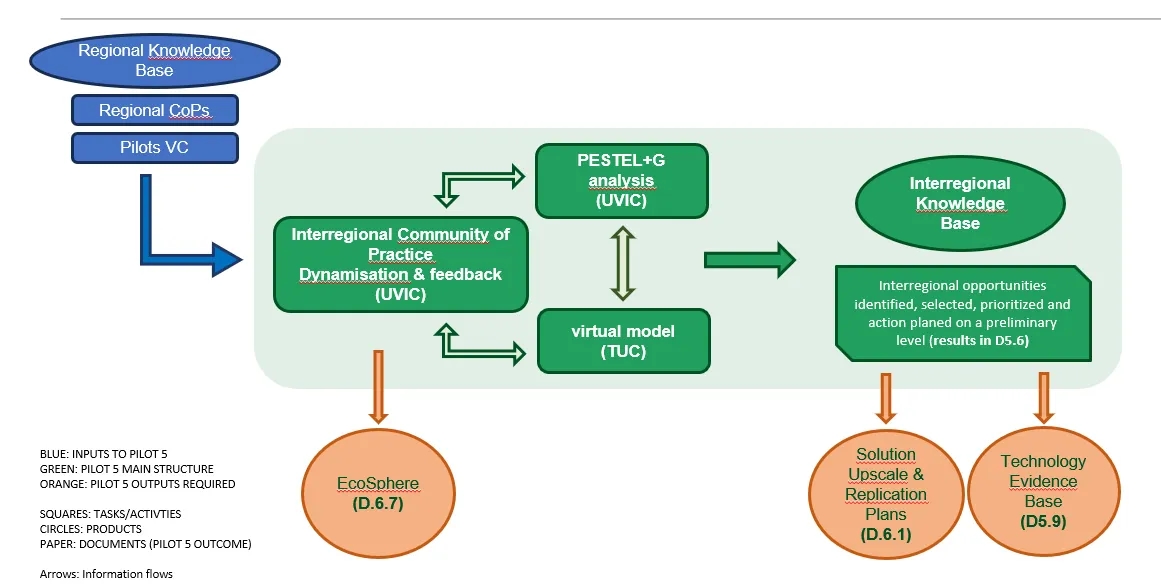
The virtual pilot examines how circular solutions developed in the four regional pilots could be connected, adapted or transferred across sectors and territories. It combines two complementary paths: virtual modelling of cross-sectoral value chains and interregional exchange through a community of practice.
The modelling path begins with the activities, resources, stakeholders and constraints of the regional pilots. These inputs are harmonised so that potential connections and transfer scenarios can be examined consistently. The work considers the agricultural and food, water and nutrient, plastics and packaging, and vehicle-lifecycle domains. Candidate links are assessed as scenarios, rather than presented as established physical exchanges.
Regional conditions are examined through a PESTELG framework covering political, economic, social, technological, environmental, legal and governance dimensions. The framework uses 35 indicators, five in each dimension, with a three-level scoring system. Twelve transfer scenarios consider each regional pilot in the three other participating regional settings. Transport and logistics are relevant alongside potential economies of scale.
The community-of-practice path supports dialogue, knowledge exchange and demonstrations of project tools. Together, the two paths connect technical modelling with the institutional and stakeholder conditions that influence replication. Pilot 5 also supports the development and testing of the project's wider upscaling and replication methodology.
The virtual assessment uses harmonised descriptions of resources, processes, actors and regional constraints from the four physical pilots. The PESTELG analysis evaluates 35 contextual indicators across seven dimensions, using scores of 0, 1 or 2 for the defined conditions.
Twelve interregional transfer scenarios provide a structured comparison of potential applications outside their original region. Analysis considers technical feasibility and the surrounding economic, logistical, social and governance conditions. Community activities add stakeholder perspectives and application questions. Simulation and contextual scores support exploration; they do not constitute measured implementation results in the receiving region.
Pilot 5 is a virtual circular systemic solution that builds on the regional value chains of Pilots 1 to 4. Their indicators, system parameters and value-chain information provide the starting point for integration and harmonisation within a simulated environment. The virtual pilot examines configurations, interactions, feasibility and adaptation to other contexts, alongside an interregional stakeholder pathway. Its reference conditions are those of the contributing regional systems, with potential interregional connections examined through simulation.
Two complementary implementation paths connect virtual modelling with regional transfer assessment. A PESTELG framework uses 35 indicators across seven dimensions to screen twelve transfer scenarios. The community structure includes Innovation Hub, Operations Hub and General channels, with a launch proposed for 5 October 2026 and surveys, workshops and tool demonstrations planned thereafter.
Initial transfer screening is awaiting partner and stakeholder validation. Community activities and scenario assessment will inform subsequent replication decisions.
Digital Tools