Pilot 2 / Value Chain 2: Nutrients for Agriculture
Sewage sludge and other organic waste streams, including aquaculture waste, food-industry waste and livestock waste, represent nutrient-rich resources. However, without an integrated circular pathway, these materials remain waste-management burdens rather than sources of energy, biochar and biofertiliser.
The Marche nutrient-recovery pathway investigates the thermochemical conversion of sewage sludge into a carbonaceous material for controlled agronomic research. The work connects material production with detailed physicochemical characterisation, soil incubation and greenhouse cultivation, allowing the properties of the recovered material to be studied before wider agricultural application is considered.
Characterisation combines carbon, hydrogen and nitrogen analysis with proximate analysis, elemental analysis by ICP, FTIR spectroscopy, zeta-potential measurements and scanning electron microscopy with elemental analysis. Together, these methods describe composition, mineral phases, surface properties and the heterogeneous carbon-mineral structure. Phosphorus-, calcium-, potassium- and iron-containing phases are among the features examined.
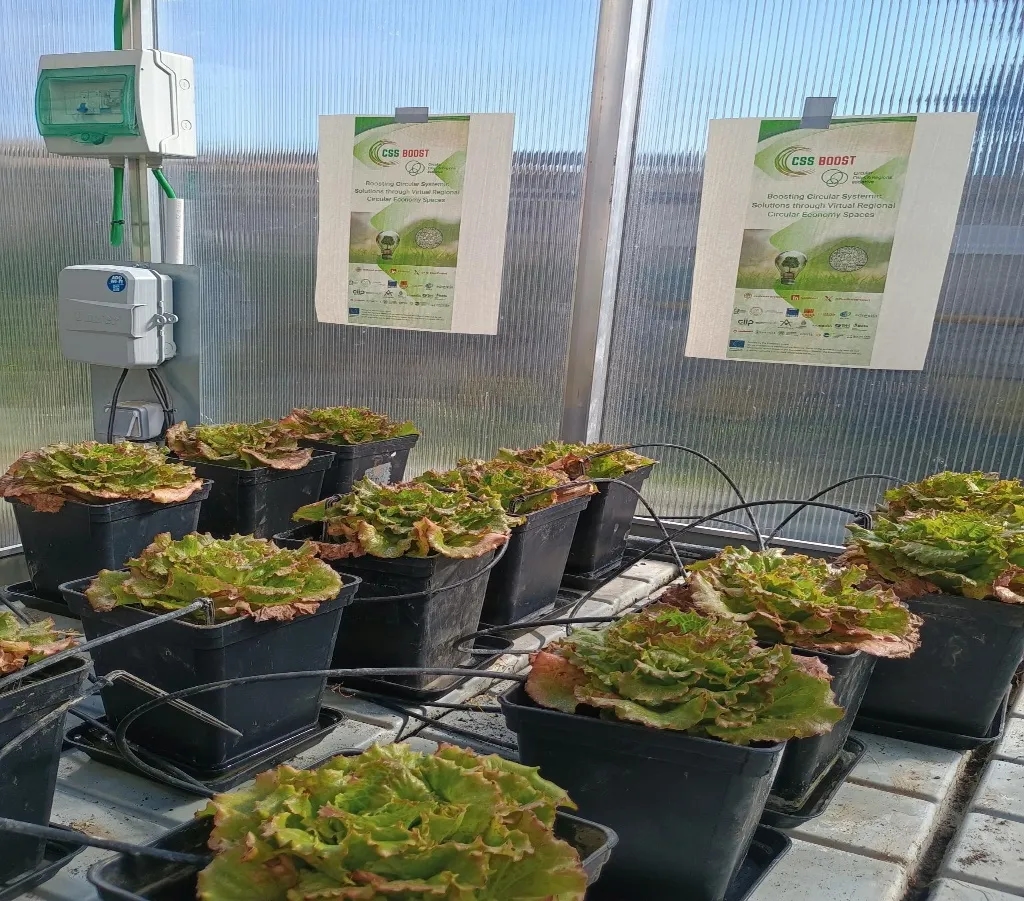
Agronomic testing includes soil incubation and a six-treatment lettuce experiment. The treatments comprise an untreated control, full mineral fertilisation, the recovered material alone, and the material combined with 100%, 75% or 50% of the mineral fertiliser rate. Monitoring includes plant growth, chlorophyll-related SPAD readings, biomass, nutrient content and soil properties. Soil incubation follows carbon dioxide evolution over an extended period to investigate carbon mineralisation.
The programme is designed to examine both immediate crop response and residual effects in subsequent cultivation. Material characterisation and experimental preparation have progressed, while crop and soil evaluation continue. Agricultural use also depends on the applicable feedstock and product requirements, separately from the material's experimental performance.
Material characterisation combines CHN and proximate analysis, ICP elemental analysis, FTIR, zeta potential and SEM with elemental analysis. Incubation follows carbon dioxide evolution over time. The greenhouse experiment compares six lettuce treatments: control, full mineral fertilisation, the recovered material alone, and the material with 100%, 75% or 50% mineral fertilisation. Measurements include growth observations, SPAD readings, biomass, plant nutrient content and soil properties, with subsequent cultivation intended to examine residual effects.
The regional reference context includes sewage sludge and organic residues from livestock farming, aquaculture and food processing. At ASITE-CIGRU in Fermo, mechanical-biological waste treatment was already established, while an anaerobic digestion section for the organic fraction of municipal waste was under permitting. The broader co-digestion feedstock mix and downstream thermochemical conversion are proposed development scenarios evaluated by the pilot.
Material characterisation is complete. Incubation experiments have continued beyond 70 days, alongside a six-treatment lettuce pot trial. Biochar delivery and preparation for subsequent validation stages are also progressing.
Agronomic testing is ongoing. Analytical reporting units and methods need consistent interpretation, and any future use remains subject to the applicable research and product requirements.