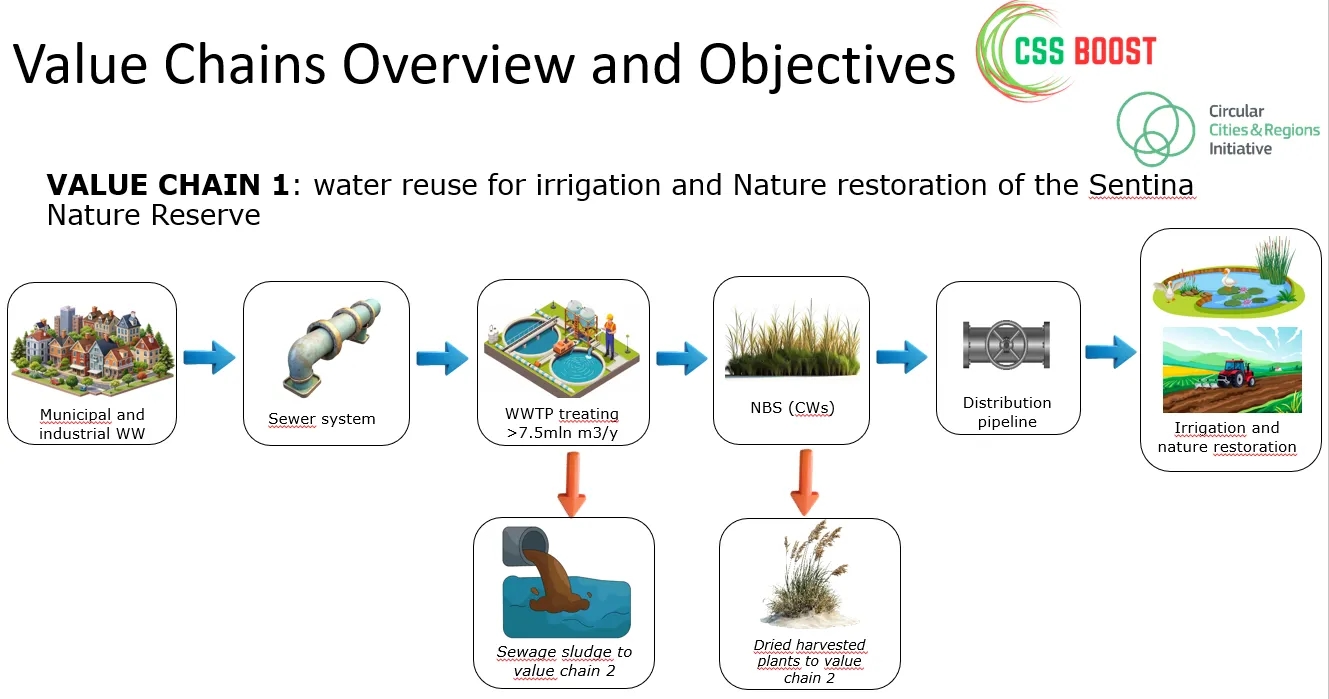
Pilot 2 / Value Chain 1: Water for Irrigation and Nature Restoration
The Sentina Natural Reserve suffers from drought during summer months. The irrigation consortium cannot fully meet the water demand needed for agricultural irrigation and for maintaining the ponds in the reserve.
At the same time, the Brodolini wastewater treatment plant could potentially provide a non-conventional water source.
The Marche water-reuse pathway combines prefiltration with two complementary nature-based treatment stages: a horizontal-flow constructed wetland and a free-water-surface wetland. It is designed to further treat effluent from the Brodolini wastewater treatment plant for potential irrigation and ecosystem-restoration applications in the Sentina area.
The horizontal-flow stage is designed for denitrification and biological treatment within a planted gravel bed. The design uses a bed slope of approximately 1%, siliceous gravel in the 5–15 mm range and Phragmites vegetation. Hydraulic conductivity, contact time and root development are important design considerations. The following free-water-surface stage combines planted areas with shallow exposed water, using sunlight, oxygen conditions and biological activity to support additional treatment and disinfection. Elodea canadensis is included in the planting design, with shallow sections intended to limit stagnation and excessive algal growth.
Implementation also covers the existing prefiltration equipment, pumping, pipework and recirculation arrangements. Ground investigations informed changes to the construction approach. The treatment design is accompanied by monitoring requirements for suspended solids, organic load, nutrients and microbiological quality, as well as salinity and turbidity. Construction and procurement activities remain part of the ongoing pilot implementation; treated-water performance will be established through monitoring of the operating system.
The monitoring scope covers water quantities and treatment quality. Quality parameters include organic load, suspended solids, nutrients, turbidity, salinity and microbiological indicators such as E. coli. The Sentina water balance separately considers pond restoration and agricultural irrigation. It estimates annual demand of 1,957,008 m³, existing canal supply of 391,910 m³ and an additional requirement of 1,565,098 m³. These quantities describe planning needs; operating data will establish actual reclaimed-water delivery and treatment performance.
The Sentina area combines water requirements for agricultural irrigation with the need to maintain ponds in the nature reserve. The existing irrigation-channel supply is insufficient to meet the area's agricultural demand. The nearby Brodolini wastewater treatment plant in San Benedetto del Tronto, managed by CIIP, provides the existing treatment infrastructure and a potential additional source of water. Water-balance assessment considers the relationship between demand, channel supply and treated effluent before the proposed polishing and reuse configuration.
The proposed system combines pre-filtration, horizontal-flow constructed wetlands and free-water-surface elements. Design, procurement and approval work are progressing, supported by the Sentina water-balance study.
The reuse system is in development. Seasonal assumptions and water-quality assessment require further technical review before commissioning and operational validation.